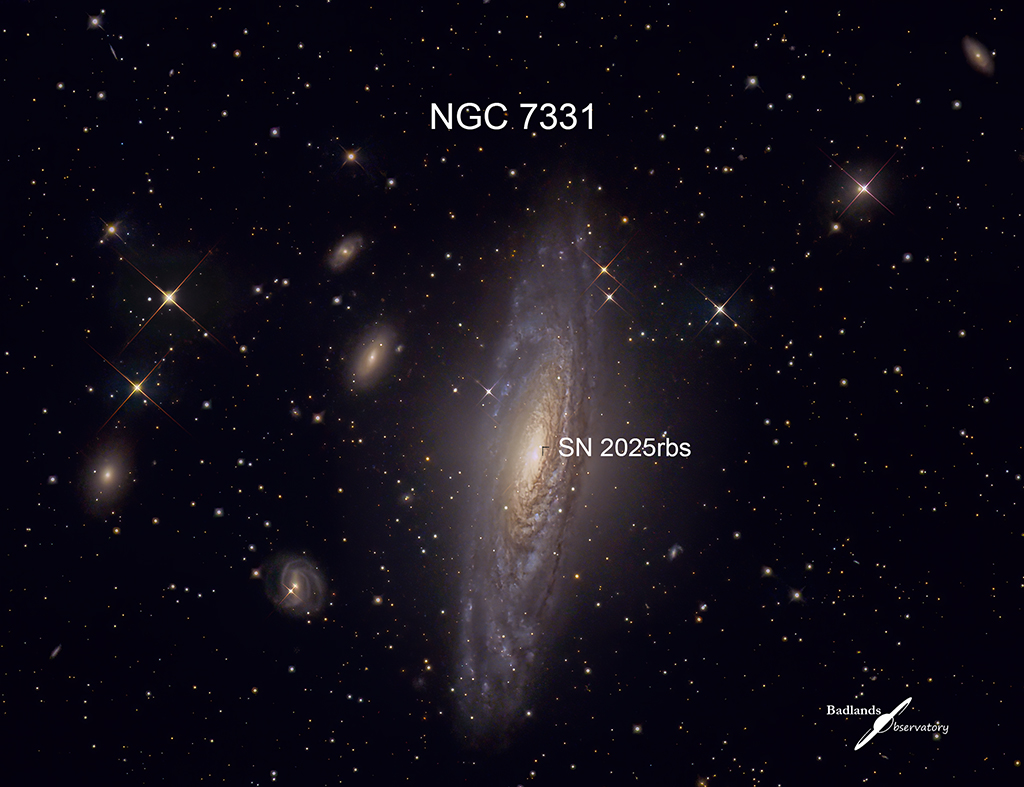
It's Galaxy Season and I'm sharing an image of my favorite galaxy. The main galaxy is NGC 7331. The collective group is also known as the Deer Lick Group. (The main galaxy is the deer and the smaller ones are known as the fleas)
I took this image on August 19, 2025 using a ZWO 6200 MC Pro astro camera attached to our 26" (diameter) telescope. As a part of the stargazing sessions we conducted at Badlands Observatory for the past 5 years, we live-stacked a series of sub-exposures for our guests and shared them to the 75" television in our lobby. For this image, I captured 340 subframes exposed at 30 seconds each and stacked them in astronomy software to bring out the detail and color.
You will note that a bright spot is labelled SN 2025rbs. On this date, we captured the galaxy at a time when a supernova had erupted and was visible within the main galaxy. Supernovae only occur in a galaxy like our Milky Way on average once every 40-100 years, so it's exciting to be able to capture one within an image.
Sadly, due to health issues, we have closed the Observatory to the public, but it was a fun time that brought visitors from all over the world. Before we began the stargazing tours, the Observatory was used to do follow-up observations of near-earth objects as a part of NASA's SpaceGuard program. If you are interested in learning more about the Observatory, our website is www.badlandsobservatory.com.
Do we miss it? Yes, we do, but we have these images as mementos of bygone days
6 comments posted
Kathleen Colligan
I don't even know how to respond to this! I am in awe of how you managed to take this fantastic photo! Oh my, 340 subframes exposed at 30 secs and then stacked is just amazing! Thank you for sharing.
Posted: 04/02/2026 00:25:05
Teresa Hofer
Kathleen, thank you very much for your comment. We are very fortunate to have a large aperture telescope under dark skies, or we would not be able to achieve this depth with so few subframes. Anyone using a small telescope or capturing subframes with narrow band filters would require many hours of exposure. I have seen captures in excess of 40 hours integration. The processing also takes a lot of times, using programs like Deep Sky Stacker and Pixinsight.
I am by no means an expert, but I do enjoy pointing the telescope and firing away, especially when there is a relatively rare occurrence like a supernova or a comet. Posted: 04/02/2026 14:56:44
Laurie McShane
I'm with Kathleen in that this is so far above anything that I can even comprehend. Bravo on an incredible shot, and thanks for sharing it with us. Posted: 04/02/2026 01:20:24
Teresa Hofer
Thanks so much, Laurie. Seeing Saturn through a telescope hooked me on astronomy and astrophotography over 20 years ago. After retirement, we made the decision to upgrade the Observatory for sharing with the public and for our own use. The tradeoff is that we are unable to take exotic trips, which makes me appreciate the photos others share all the more. Posted: 04/02/2026 15:02:32
Harrison Ball
Teresa, what an amazing image! I love the subtle colors. You are clearly dedicated to astrophotography. Posted: 04/02/2026 22:19:52
Peter Bean
This is a stunning astrophotography image. I would have liked to see it without the white lettering. With the annotation it belongs in an astronomy book. Without, it stands alone as the absolutely spectacular image that it is. Posted: 04/16/2026 21:45:44