Sherry Icardi
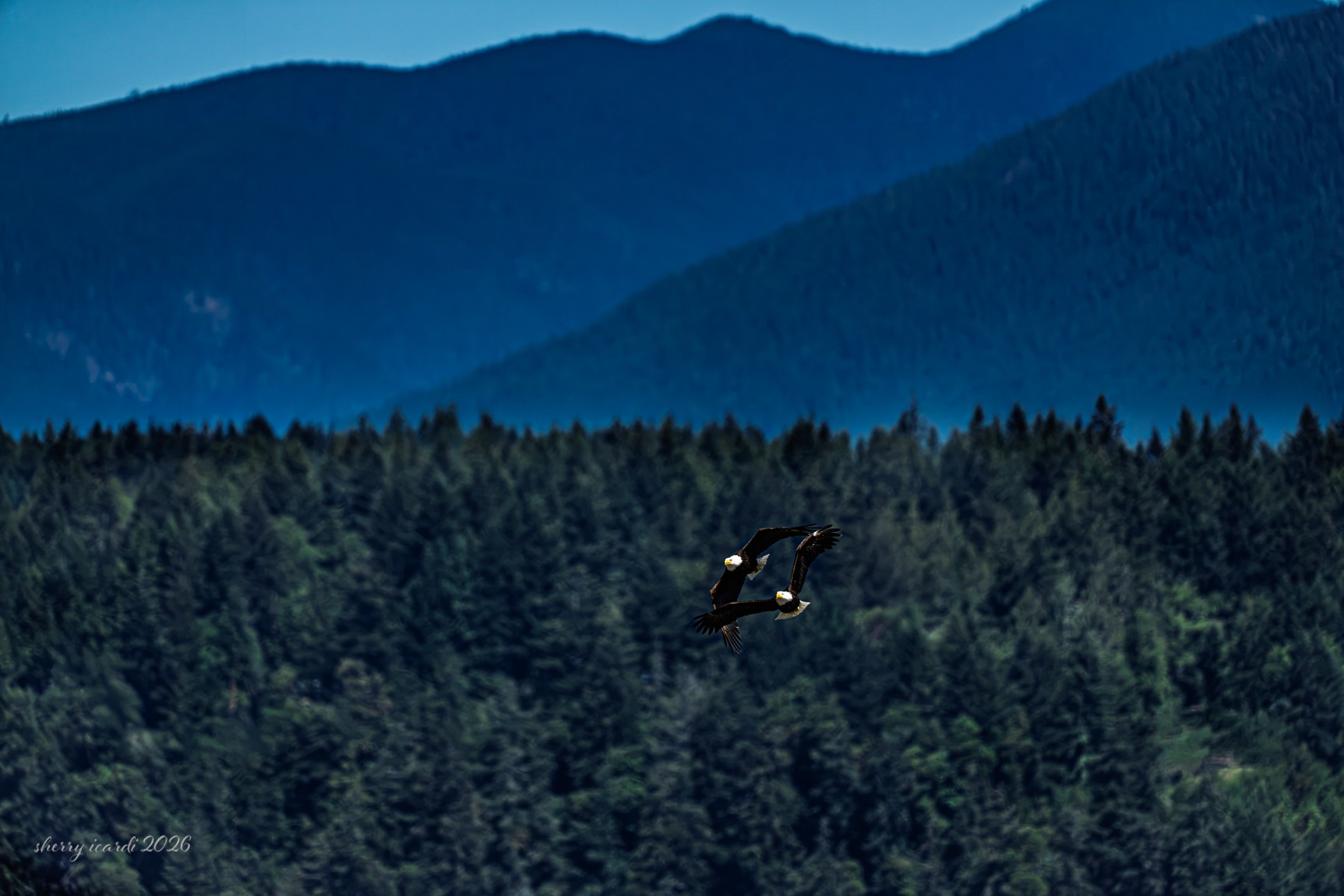
July 2026 - The Cascades
About the Image(s)
Taken in early June while in Washington State. We went to Seabeck, WA to photograph Eagles and I was in Heaven….not just because of the Eagles but the beautiful landscape that accompanied them. And while it is not a traditional landscape as I normally think of….it is a realistic image of the beautiful Cascades in this part of Washington. Of course with my wildlife interests, why would I not include an Eagle or two?
The settings are not what you would expect, I was there with my Long lens shooting Eagles and I improvised to get both the mountains and the Eagles.
Taken with Sony A1 and FE 300mm and 2x converter giving me 600 mm
1/3200sec
F/5.6
ISO 320
Two frames stitched together and I sharpened the birds a bit and darkened the background colors (I did not want to lose any detail of the birds). I added Denoise, and I used a gradient on the top to darken their colors, I also added some texture to the Cascades to bring out the feeling of trees and leaves. Since I don’t know much about the Cascades, I suspect the front tress the birds are against are actually part of the mountain range. Just less height…but I'm not certain of that. In case you are wondering I also got incredible shots of the birds!
4 comments posted
This is a well-conceived environmental wildlife image that emphasizes not only the birds but also the grandeur of their surroundings. The layered blue mountains and expansive forest create a strong sense of place and convey the scale and wildness of the landscape. The atmospheric perspective adds depth inviting the viewer to take in the setting as much as the subjects themselves.
The two bald eagles provide the image's narrative element. And their interaction in flight introduces energy and intrigue, i.e., is it courtship, play, or territorial behavior? Good questions to leave unanswered. However, the birds occupy a very small portion of the frame, the viewer's attention is divided between the scenery and the eagles - neither fish nor fowl.
As presented, the photograph succeeds more as an environmental portrait of eagles inhabiting a vast wilderness - it's peaceful, evocative, with rich in atmosphere. However, it's too dark, so I suggest moving your exposure slider to about +1.4 to +1.5
Lastly, I'm unclear if you added the eagles or just stitched to images with one containing the ealges.
Posted: 07/01/2026 22:41:38
The reason I did not lighten it more was twofold, they were naturally very dark, but more importantly I tried to increase the shadows but it brings out the haze of the ever present fog! I found that distracting! You can still see some residual at the base of the cascades. Posted: 07/02/2026 17:24:02